
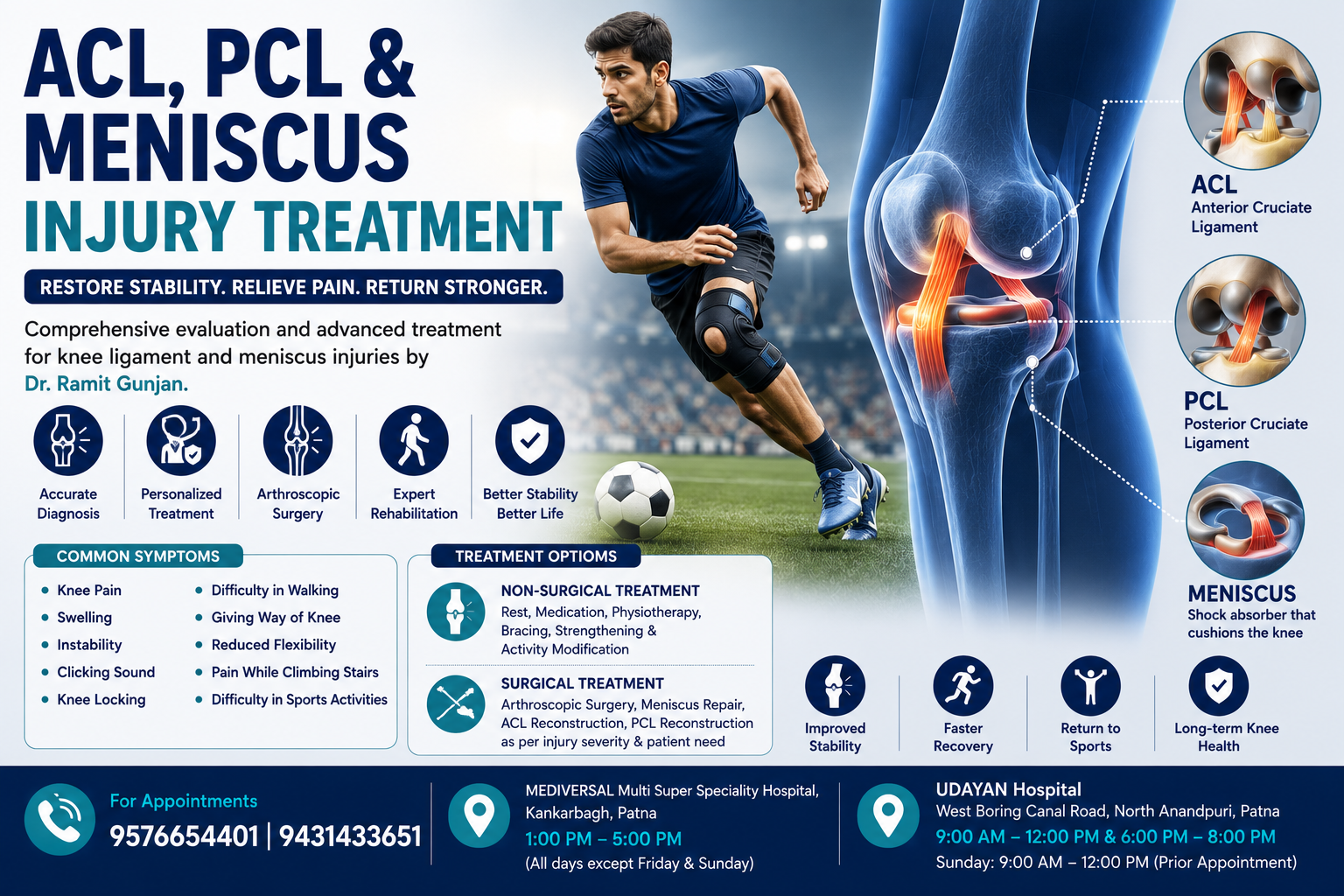
ACL, PCL & Meniscus Injury Treatment in Patna
Comprehensive Knee Ligament Care for Improved Stability and Mobility
The knee is one of the most active and complex joints in the human body. It relies on strong ligaments and cartilage to provide stability, support movement, and absorb impact during everyday activities. Injuries to the ACL (Anterior Cruciate Ligament), PCL (Posterior Cruciate Ligament), or Meniscus can lead to pain, swelling, instability, and difficulty walking or participating in sports.
These injuries are commonly seen in athletes but can also occur after falls, road traffic accidents, sudden twisting movements, or workplace injuries. Early diagnosis and appropriate treatment play an important role in restoring knee function and preventing further joint damage.
Dr. Ramit Gunjan, an experienced Orthopedic Surgeon in Patna, provides comprehensive evaluation and personalized treatment plans for ligament and meniscus injuries. Every treatment recommendation is based on detailed clinical examination, diagnostic imaging, activity level, and the patient’s individual needs.
Understanding the Knee Joint
The knee joint is formed by the femur (thigh bone), tibia (shin bone), and patella (kneecap). Several important structures work together to provide stability and smooth movement.
These include:
- Anterior Cruciate Ligament (ACL)
- Posterior Cruciate Ligament (PCL)
- Medial Collateral Ligament (MCL)
- Lateral Collateral Ligament (LCL)
- Medial Meniscus
- Lateral Meniscus
- Articular Cartilage
- Surrounding Muscles and Tendons
Damage to any of these structures may result in pain, swelling, instability, and restricted movement.
What is an ACL Injury?
The Anterior Cruciate Ligament (ACL) is one of the primary stabilizing ligaments of the knee. It helps control forward movement and rotational stability.
ACL injuries commonly occur during:
- Sudden twisting movements
- Sports involving jumping or pivoting
- Football
- Cricket
- Basketball
- Badminton
- Falls
- Road traffic accidents
A complete ACL tear often causes significant knee instability and may require specialized orthopedic management.
What is a PCL Injury?
The Posterior Cruciate Ligament (PCL) prevents the shin bone from moving excessively backward relative to the thigh bone.
PCL injuries usually occur due to:
- Road traffic accidents
- Direct impact on the knee
- Sports injuries
- Falls from height
Some PCL injuries can be managed conservatively, while others may require surgical treatment depending on the severity.
What is a Meniscus Tear?
The meniscus consists of two C-shaped cartilage cushions that act as shock absorbers inside the knee joint.
Meniscus injuries commonly occur due to:
- Twisting the knee while bearing weight
- Sports injuries
- Sudden directional changes
- Age-related degeneration
- Squatting with excessive force
Depending on the location and severity of the tear, treatment may involve rehabilitation or arthroscopic surgery.
Common Symptoms of Ligament and Meniscus Injuries
Symptoms may vary depending on the specific injury but commonly include:
- Sudden knee pain
- Swelling
- Knee instability
- Difficulty walking
- Clicking sensation
- Knee locking
- Reduced range of motion
- Pain while climbing stairs
- Difficulty squatting
- Feeling that the knee may “give way”
- Pain during sports activities
- Difficulty changing direction while walking
Persistent symptoms should be evaluated by an orthopedic specialist.
Common Causes of ACL, PCL & Meniscus Injuries
Ligament and cartilage injuries may occur due to:
- Sports injuries
- Sudden twisting movements
- Direct impact to the knee
- Falls
- Road traffic accidents
- Jumping and awkward landings
- Contact sports
- Workplace injuries
- Degenerative cartilage changes
- Previous untreated knee injuries
Identifying the underlying cause helps guide appropriate treatment planning.
Who is at Higher Risk?
Certain individuals may have an increased risk of knee ligament injuries, including:
- Athletes
- Runners
- Football players
- Basketball players
- Badminton players
- Gym enthusiasts
- Individuals with physically demanding occupations
- People with previous knee injuries
- Individuals participating in high-impact sports
Proper conditioning and injury prevention strategies can help reduce risk.
Diagnosis of Knee Ligament Injuries
A detailed orthopedic evaluation helps determine the type and severity of the injury.
Assessment may include:
- Detailed medical history
- Physical examination
- Knee stability tests
- Walking assessment
- Digital X-rays
- MRI Scan
- Functional assessment
- Range of motion evaluation
These investigations help determine whether conservative treatment or surgical intervention is most appropriate.
Treatment Options
Treatment depends on:
- Type of ligament injury
- Severity of the tear
- Age
- Activity level
- Sports participation
- Overall health
- Functional goals
Non-Surgical Treatment
Many ligament injuries improve without surgery.
Conservative treatment may include:
- Rest
- Ice therapy
- Compression
- Elevation (RICE)
- Medications
- Physiotherapy
- Knee braces
- Activity modification
- Muscle strengthening exercises
- Sports rehabilitation
Arthroscopic Surgery
For selected patients, minimally invasive arthroscopic surgery may be recommended to repair or reconstruct injured structures.
Arthroscopy allows the surgeon to examine and treat the knee through small incisions using specialized instruments.
ACL Reconstruction
Patients with complete ACL tears and significant instability, particularly those wishing to return to sports or physically demanding activities, may be candidates for ACL reconstruction after detailed evaluation.
Meniscus Repair or Meniscectomy
Depending on the location and pattern of the tear, the meniscus may be repaired or trimmed using arthroscopic techniques.
The treatment approach is individualized to preserve as much healthy meniscal tissue as possible whenever appropriate.
Conditions Commonly Evaluated
Dr. Ramit Gunjan provides evaluation and treatment for:
- ACL Tears
- PCL Tears
- Meniscus Tears
- Knee Ligament Injuries
- Sports-Related Knee Injuries
- Knee Instability
- Cartilage Injuries
- Multi-Ligament Knee Injuries
- Recurrent Knee Pain
- Knee Locking
- Knee Swelling
- Chronic Sports Injuries
Every patient receives a personalized treatment plan designed to restore knee stability, improve mobility, and support a safe return to daily activities or sports.
Benefits of Early Treatment for ACL, PCL & Meniscus Injuries
Timely diagnosis and appropriate treatment are important for protecting the knee joint and restoring normal function. Delaying treatment may increase the risk of persistent instability, cartilage damage, recurrent injuries, and long-term joint problems.
Potential benefits of early treatment include:
- Reduced knee pain and swelling
- Improved knee stability
- Better joint function
- Restoration of normal movement
- Reduced risk of additional cartilage injury
- Improved ability to perform daily activities
- Better long-term knee health
- Personalized treatment based on the specific injury
Treatment outcomes depend on the severity of the injury, the patient’s activity level, rehabilitation, and overall health.
Recovery and Rehabilitation
Recovery varies depending on the type of ligament injury, treatment approach, and the patient’s commitment to rehabilitation.
A structured rehabilitation program plays a crucial role in restoring knee strength, flexibility, balance, and stability.
Early Recovery Phase
Immediately after treatment, patients may receive guidance regarding:
- Pain management
- Swelling control
- Knee protection
- Weight-bearing instructions
- Use of braces (when required)
- Safe movement techniques
Physiotherapy
Physiotherapy is an essential part of recovery and may include:
- Range-of-motion exercises
- Quadriceps strengthening
- Hamstring strengthening
- Balance training
- Knee stability exercises
- Functional rehabilitation
- Sports-specific rehabilitation when appropriate
Every rehabilitation program is tailored to the patient’s injury and recovery progress.
Returning to Daily Activities
Patients gradually resume routine activities based on:
- Knee stability
- Pain levels
- Muscle strength
- Functional improvement
- Medical guidance
The recovery timeline varies for each individual.
Returning to Sports
For athletes and physically active individuals, returning to sports requires careful assessment to reduce the risk of reinjury.
Your orthopedic surgeon and physiotherapist will evaluate:
- Knee stability
- Strength of supporting muscles
- Range of motion
- Balance
- Functional performance
- Sport-specific movement patterns
A gradual return-to-sport program is recommended after achieving appropriate recovery milestones.
Tips to Prevent Ligament Injuries
Although not every injury can be prevented, adopting healthy practices may help reduce the risk.
Recommendations include:
- Warm up before exercise
- Strengthen leg and core muscles
- Practice proper sports techniques
- Improve balance and coordination
- Wear appropriate footwear
- Use protective sports equipment
- Avoid sudden increases in training intensity
- Maintain flexibility
- Allow adequate recovery between workouts
- Address minor injuries early
These measures contribute to better knee health and injury prevention.
Why Choose Dr. Ramit Gunjan?
Dr. Ramit Gunjan provides patient-centered orthopedic care with an emphasis on accurate diagnosis, evidence-based treatment, and individualized rehabilitation.
Patients choose Dr. Ramit Gunjan for:
- Comprehensive orthopedic evaluation
- Expertise in sports injury management
- Personalized treatment planning
- Advanced arthroscopic techniques
- Modern diagnostic approach
- Evidence-based orthopedic care
- Compassionate patient care
- Individualized rehabilitation guidance
- Focus on restoring knee stability and function
Each treatment plan is customized according to the patient’s injury pattern, activity level, occupation, and long-term goals.
Frequently Asked Questions (FAQs)
How do I know if I have an ACL injury?
An ACL injury often occurs after a sudden twisting movement and may be associated with a popping sensation, swelling, instability, and difficulty walking. A proper orthopedic evaluation and imaging studies are needed for diagnosis.
Can ligament injuries heal without surgery?
Some partial ligament injuries and selected PCL injuries may be managed successfully with physiotherapy and rehabilitation. Treatment depends on the severity of the injury, symptoms, and activity level.
Is surgery always necessary for a meniscus tear?
No. Many meniscus injuries improve with conservative treatment. Surgery is recommended only when appropriate based on the type of tear, symptoms, and functional limitations.
What is ACL reconstruction?
ACL reconstruction is a surgical procedure that replaces a torn ACL with a graft to restore knee stability. It is commonly considered for patients with complete ACL tears and significant functional instability.
How long does rehabilitation take?
Recovery varies depending on the injury, treatment method, and rehabilitation progress. Your orthopedic surgeon and physiotherapist will provide individualized guidance.
Can I return to sports after ligament treatment?
Many patients return to sports following successful treatment and rehabilitation. The timing depends on knee stability, strength, healing, and medical assessment.
What happens if ligament injuries are ignored?
Untreated ligament injuries may lead to persistent instability, recurrent injuries, cartilage damage, meniscus tears, and an increased risk of early osteoarthritis.
Why Early Diagnosis Matters
Persistent knee pain, swelling, or instability should not be ignored. Early orthopedic evaluation allows accurate diagnosis, timely treatment, and appropriate rehabilitation. Prompt management can help protect the knee joint, improve recovery, and reduce the risk of future complications.
Related Orthopedic Services
You may also be interested in:
- Arthroscopy Surgery
- Sports Injury Treatment
- Knee Replacement Surgery
- Joint Replacement Surgery
- Arthritis Treatment
- Bone Fracture Treatment
- Trauma & Fracture Care
- Back Pain Treatment
- Neck Pain Treatment
Book Your Consultation with Dr. Ramit Gunjan
If you are experiencing knee pain, instability, swelling, or have suffered a sports-related ligament injury, consult Dr. Ramit Gunjan, an experienced Orthopedic Surgeon in Patna, for a comprehensive evaluation and personalized treatment plan.
📍 Consultation Available At
🏥 MEDIVERSAL Multi Super Speciality Hospital, Kankarbagh
🕐 1:00 PM – 5:00 PM
(All days except Friday & Sunday)
🏥 UDAYAN Hospital
📍 West Boring Canal Road, North Anandpuri, Patna
🕘 9:00 AM – 12:00 PM & 6:00 PM – 8:00 PM
Sunday: 9:00 AM – 12:00 PM (Prior Appointment)
📞 Appointments
9576654401 | 9431433651